
Albert Einstein: Relativity, Genius and the Nature of Reality
The Genius Who Changed Space and Time
Skygaze explores the remarkable life, revolutionary discoveries, famous thought experiments, and enduring questions surrounding the scientist who transformed humanity's understanding of reality.
From Curious Student to Patent Clerk
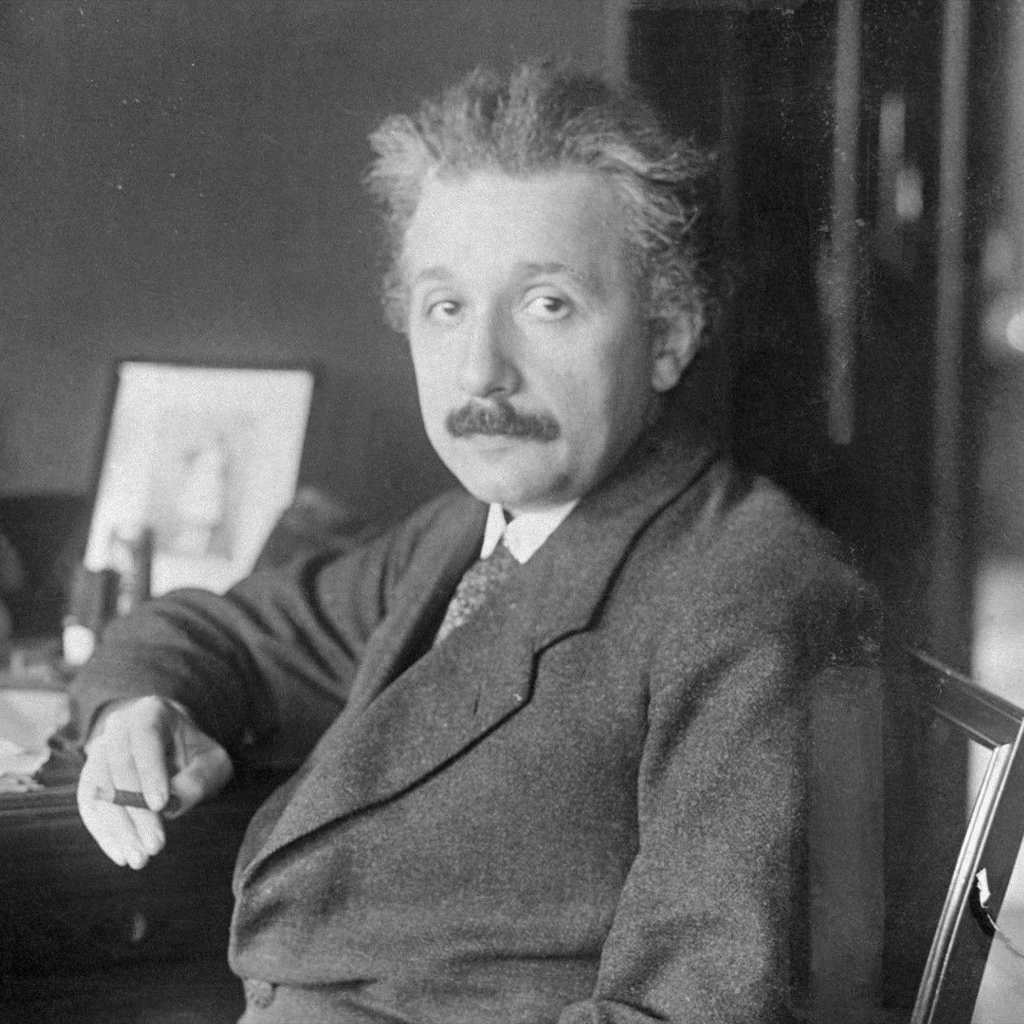
Albert Einstein was born in Ulm in 1879 and grew up in a middle-class Jewish family. As a child he became fascinated by invisible forces after seeing a magnetic compass and wondering what caused its needle to move. He later developed a deep interest in mathematics, light, electricity, and the hidden laws governing nature.
Einstein's relationship with formal education was sometimes difficult. He disliked rigid teaching methods and preferred independent thought, but the familiar claim that he failed mathematics is untrue. He demonstrated strong mathematical ability from a young age and eventually studied physics and mathematics at the Swiss Federal Polytechnic in Zurich.
After graduation, Einstein struggled to secure an academic position and accepted work at the Swiss Patent Office in Bern. The job involved examining technical inventions, but it also gave him time to think. During these years, he developed ideas that would overturn centuries of assumptions about motion, light, space, and time.
The Miracle Year That Transformed Physics
In 1905, while still employed at the patent office, Einstein published four groundbreaking papers in what became known as his annus mirabilis, or miracle year. Each addressed a major problem in physics, and together they helped launch a new scientific era.
One paper explained the photoelectric effect by proposing that light behaves as though it arrives in individual packets of energy, later called photons. Another used the motion of tiny particles suspended in liquid to provide powerful evidence for the existence of atoms. A third introduced the special theory of relativity, revealing that measurements of space and time depend upon the motion of the observer.
The fourth paper presented the relationship between mass and energy summarized by the famous equation E=mc^2. It showed that even a small amount of mass contains an enormous quantity of energy, establishing a principle that would influence nuclear physics, astronomy, and humanity's understanding of matter.
Relativity and the Elastic Nature of Time
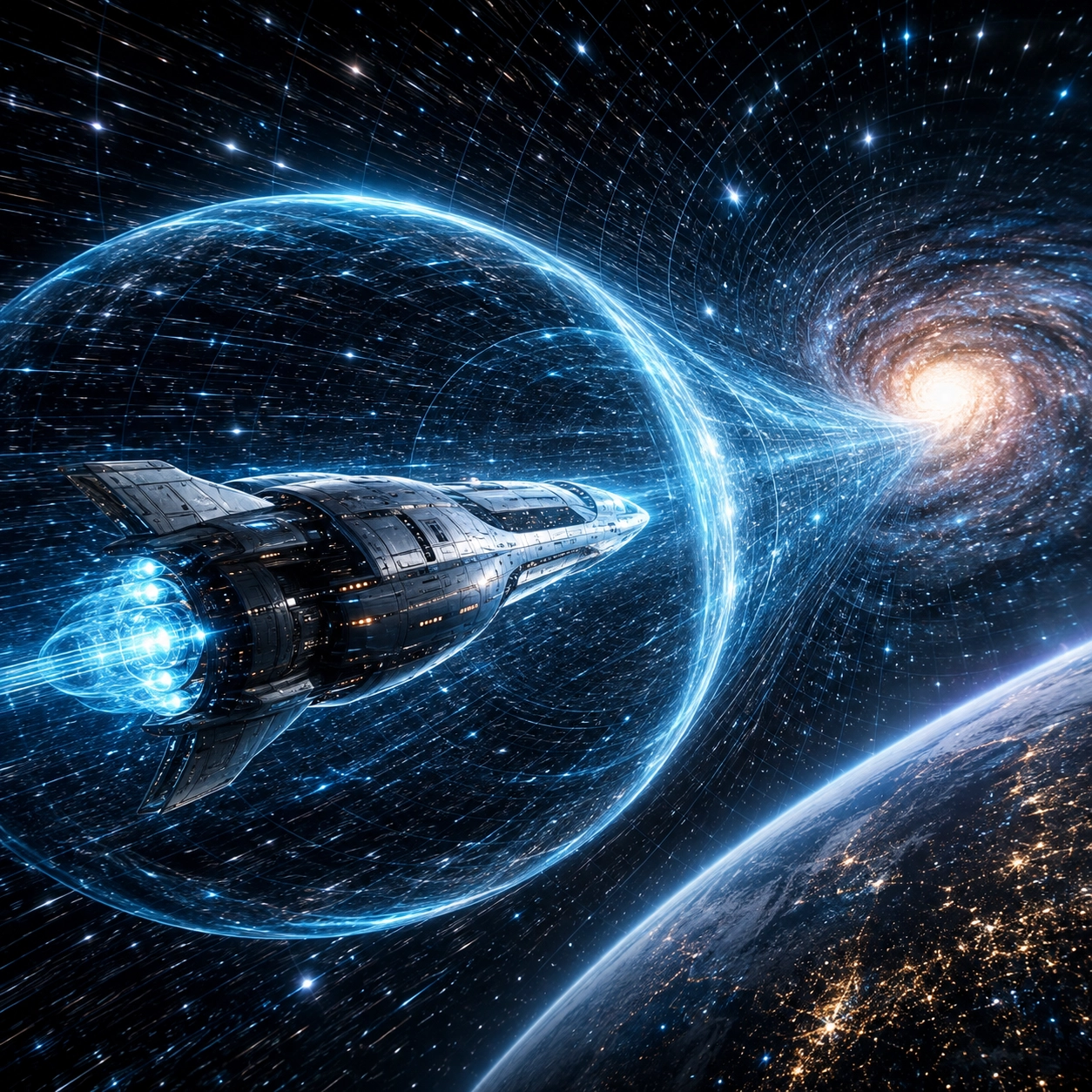
Before Einstein, space and time were generally treated as fixed and universal. Special relativity challenged that view. Einstein showed that observers moving at different speeds can measure different distances and different amounts of elapsed time while still agreeing on the speed of light.
One consequence is time dilation: a rapidly moving clock passes through time more slowly relative to a clock at rest. This is not merely a philosophical idea. The effect has been measured with precise clocks, observed in fast-moving particles, and accounted for in technologies such as satellite navigation.
Relativity therefore permits a limited form of travel into the future. A person moving close to the speed of light could experience less elapsed time than people who remained behind. Explore how these ideas connect with the larger mystery of time travel and the possibility that time may be far stranger than everyday experience suggests.
Gravity as the Curvature of Spacetime
Einstein spent the next decade developing a broader theory capable of explaining gravity. In 1915, he completed the general theory of relativity, replacing the familiar picture of gravity as an invisible pulling force with a radically different idea.
According to general relativity, mass and energy curve spacetime. Planets orbit stars because they follow paths through this curved geometry, while light can bend as it passes near massive objects. In 1919, observations made during a solar eclipse appeared to confirm Einstein's prediction that the Sun's gravity would deflect light from distant stars, making him an international celebrity.
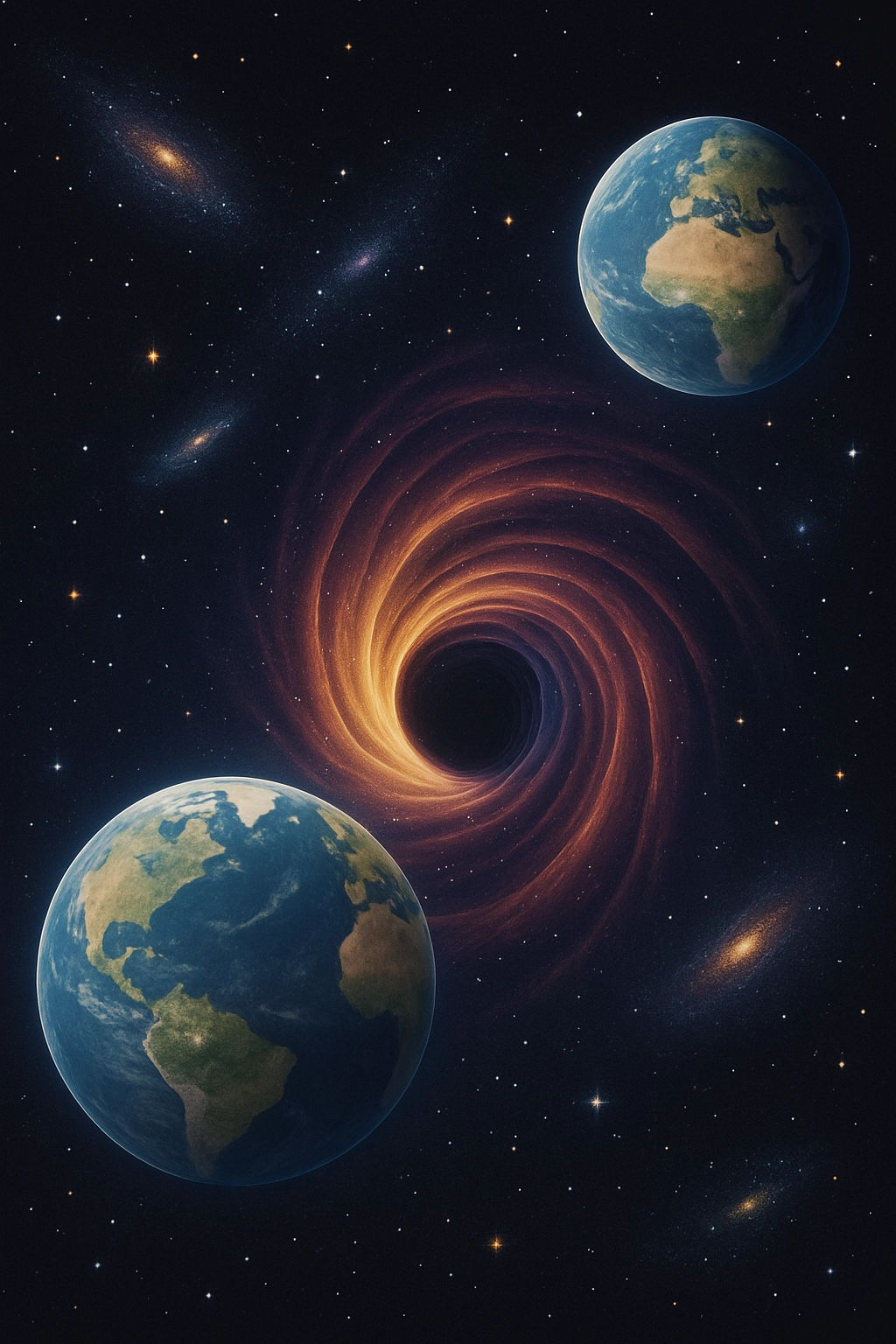
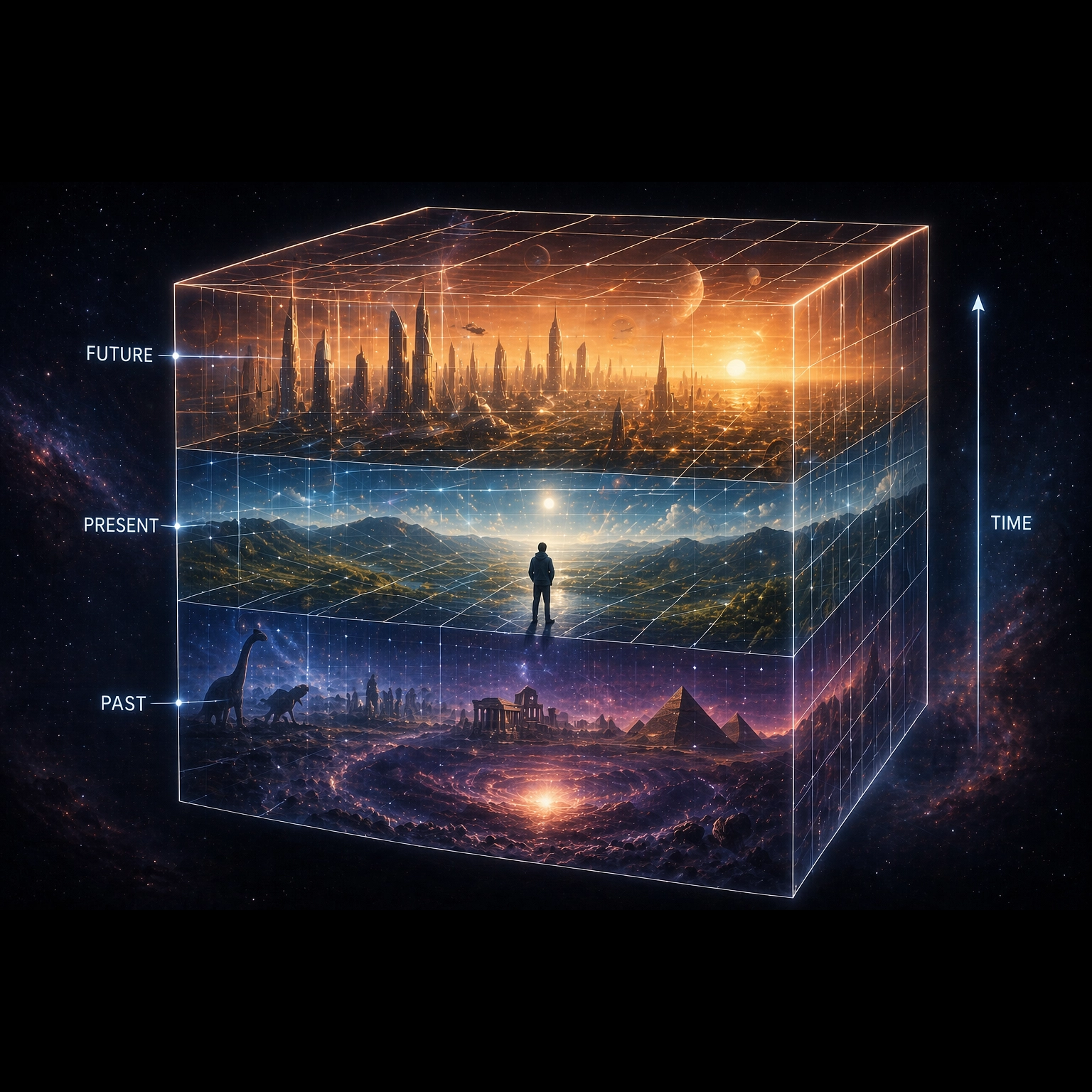
The theory later predicted or helped explain black holes, gravitational lenses, gravitational waves, the expansion of the universe, and differences in the passage of time caused by gravity. Clocks run slightly more slowly in stronger gravitational fields, showing that time is not an independent background but part of the physical structure of the universe.
Quantum Physics and an Unfinished Debate
Einstein helped establish quantum theory through his explanation of the photoelectric effect, yet he became deeply uncomfortable with the increasingly probabilistic interpretation of quantum mechanics. He believed that physical reality should possess an underlying order, even when that order remained hidden from observation.
His debates with physicist Niels Bohr became legendary. Einstein challenged the idea that chance and measurement played fundamental roles in nature, proposing thought experiments intended to expose weaknesses in quantum theory. Although later experiments supported many predictions of quantum mechanics, Einstein's objections helped sharpen the theory and inspired research into quantum entanglement.
These questions remain closely connected to the mystery of what reality actually is. Does time flow independently, or is it a dimension shaped by matter, motion, memory, and observation? Explore the possibility that time does not truly exist in the form our minds experience it.
War, Responsibility, and the Atomic Age
Einstein left Germany after Adolf Hitler and the Nazi Party came to power in 1933, eventually settling in the United States. A committed critic of fascism, nationalism, and racial discrimination, he used his international reputation to support refugees, civil rights, peaceful cooperation, and the creation of a Jewish homeland that could coexist with its neighbours.
In 1939, physicist Leo Szilard encouraged Einstein to sign a letter warning United States President Franklin D. Roosevelt that Nazi Germany might attempt to develop an atomic weapon. The letter helped draw government attention to nuclear research, although Einstein did not work on the Manhattan Project and played no direct role in constructing the atomic bomb.
After the war, Einstein advocated international control of nuclear technology and warned of the dangers posed by weapons capable of destroying civilization. His experience illustrated the difficult relationship between scientific discovery and the uses societies ultimately make of knowledge.
A Mind That Reshaped Reality
Albert Einstein transformed physics by showing that space, time, matter, energy, and gravity are deeply interconnected. His theories changed astronomy and cosmology while also affecting practical technologies that depend upon precise measurements of time and motion.
Einstein did not work in isolation from the scientific past. Isaac Newton had described gravity and motion with extraordinary accuracy more than two centuries earlier. Einstein did not simply prove Newton wrong; he revealed that Newton's laws are an excellent approximation within ordinary conditions, while relativity becomes necessary at extreme speeds, immense distances, and powerful gravitational fields.
More than a century after his miracle year, Einstein remains a symbol of curiosity, independence, and intellectual courage. Skygaze invites readers to remember him not only for a famous equation or untamed hair, but as the thinker who showed that reality is far less fixed and far more mysterious than humanity had ever imagined.